
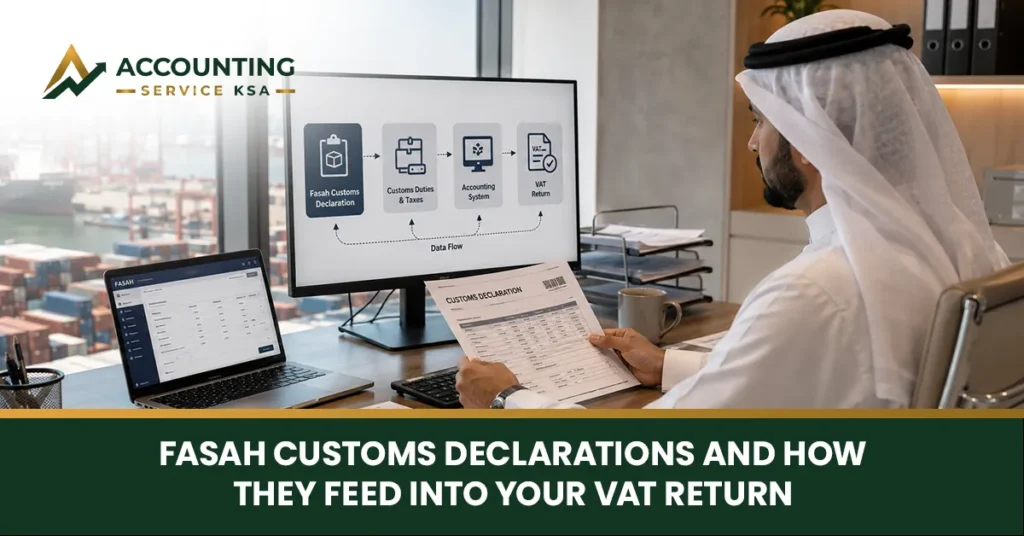
If you import or export goods in Saudi Arabia, the paperwork you file through Fasah does not stay in a silo. It flows directly into how ZATCA calculates, cross-checks, and verifies your import VAT. Understanding this connection is essential for accurate reporting, and it is one of the most common areas where businesses get their fasah customs vat return wrong. At Accounting Services KSA, we regularly help clients reconcile Fasah data with their VAT filings, and this guide breaks down exactly how the two systems interact, where the risks sit, and how to keep your reporting clean.
Understanding Fasah and Its Role in Your VAT Filing
Fasah is the Saudi customs single-window platform that manages the clearance of imported and exported shipments. Every declaration filed through Fasah generates data HS codes, declared values, duty calculations, and clearance timestamps that ZATCA cross-references when reviewing your fasah customs vat return. This is why a fasah declaration vat mismatch, even a small one, can trigger follow-up questions during a VAT audit.
Businesses that treat Fasah as just a customs formality often miss the fact that the platform is effectively feeding a live data trail ZATCA can pull at any time. Getting the declaration right the first time saves hours of reconciliation later, and it keeps your VAT position defensible if it is ever questioned.
It also matters because customs and tax reporting in Saudi Arabia are no longer treated as separate compliance tracks. The two systems talk to each other, and a business that manages them independently is far more likely to end up with numbers that don’t line up when ZATCA compares its own records to what was filed. For finance teams juggling multiple shipments a month, an accurate fasah customs vat return starts with getting the underlying fasah declaration vat entry right on day one, not with fixing it retroactively at filing time.
Small importers sometimes assume this level of reconciliation only matters for large logistics operations, but the reality is that even a handful of shipments a year can create a fasah customs vat return discrepancy large enough to draw attention, particularly if the same error repeats across multiple filings.
How Fasah Declarations Feed Into Your VAT Return
The relationship between Fasah and your VAT return follows a fairly predictable path, and understanding each step makes it much easier to spot where errors typically creep in.
- Goods arrive and a declaration is filed. The importer or their customs broker submits shipment details through Fasah, including declared value, country of origin, and tariff classification.
- Import VAT is calculated. Based on the customs value declared in Fasah, ZATCA determines the fasah import vat amount due, which is usually payable before the goods are released.
- Data syncs with ZATCA’s systems. The declared values, duty paid, and VAT paid are logged against your organization’s tax identification number.
- You report the same figures in your VAT return. The import VAT paid should match what Fasah recorded, and this figure becomes part of your input VAT claim for that period.
Any discrepancy between what was declared in Fasah and what later appears on your VAT return is one of the fastest ways to invite scrutiny into your fasah customs vat return. Even timing differences, where a shipment clears in one month but is reported in the accounts a month later, can raise questions if not properly documented.
Fasah Declaration Types and VAT Treatment
Not every Fasah declaration carries the same VAT implications, and this is where many finance teams lose track of the details. The table below outlines the common declaration categories and how each typically affects your return.
| Declaration Type | Fasah Purpose | VAT Treatment | Common Pitfall |
| Standard Import Declaration | Regular commercial imports | Import VAT due at point of clearance | Undervaluing goods to reduce duty |
| Temporary Admission | Goods entering for a limited period | Usually VAT-suspended, conditions apply | Missing the re-export deadline |
| Re-Export Declaration | Goods leaving after temporary entry | No import VAT if conditions are met | Incomplete documentation trail |
| Customs Warehousing | Goods stored under bond | VAT deferred until release | Confusing release date with entry date |
| Free Zone Movement | Transfers within bonded zones | Often VAT-exempt | Incorrect zone classification |
Getting the classification right at the point of filing is the foundation of accurate customs fasah accounting, because the VAT treatment cascades directly from how the declaration is categorized in the system. Misclassifying a fasah declaration vat entry at this stage is one of the most common root causes of a mismatched fasah customs vat return later on, so it is worth double-checking category assignment before a shipment is finalized.
Common Fasah Customs ZATCA Errors That Affect VAT Accuracy
Several recurring issues show up when we review client accounts, and most of them are avoidable with a bit more structure around the filing process.
- Value mismatches: the customs value recorded in Fasah differs from the invoice value used in the accounting system.
- Timing errors: VAT is recorded in the wrong tax period relative to the actual Fasah clearance date.
- HS code misclassification: leads to an incorrect duty and VAT calculation from the outset.
- Missing supporting documents: invoices or bills of lading that don’t match what was submitted in Fasah.
- Currency conversion gaps: exchange rate differences between the customs declaration and the bookkeeping entry.
These fasah customs zatca issues are rarely deliberate, but they are exactly what ZATCA’s automated cross-checks are designed to catch. A clean fasah customs zatca trail, with every figure traceable back to its source declaration, protects a business from unnecessary penalties and long back-and-forth exchanges during an audit.
Best Practices for Customs Fasah Accounting
To keep your books and your customs declarations aligned on an ongoing basis, a few habits make a significant difference:
- Reconcile Fasah clearance records with your accounting system monthly, not just at VAT return time.
- Assign a consistent HS code library internally so classification doesn’t vary between shipments or staff members.
- Keep a digital archive of every Fasah declaration alongside its matching invoice and bill of lading.
- Train whoever handles customs filings to understand basic VAT treatment, not just clearance procedures.
- Run a quarterly spot-check comparing a sample of Fasah declarations against the VAT return figures for the same period.
Strong customs fasah accounting habits mean fewer surprises when ZATCA requests supporting evidence for your fasah customs vat return, and they reduce the time your team spends firefighting during an actual audit.
Staying Compliant: Fasah Import VAT and ZATCA Expectations
ZATCA expects the fasah import vat figure declared at the border to flow through, essentially unchanged in substance, into your periodic VAT return. If your accounting team applies adjustments for freight, insurance, or currency conversion those adjustments need to be documented and clearly traceable back to the original Fasah entry.
The safest approach is to treat Fasah data as the source of truth for import VAT, then layer your accounting entries on top of it, rather than reconstructing figures independently and hoping they match. This keeps your fasah customs vat return defensible if ZATCA ever asks for a full walkthrough of a specific shipment.
Conclusion
Fasah and your VAT return are not two separate processes; they are two views of the same underlying transaction. Every declaration filed at the border eventually surfaces in your tax reporting, and businesses that stay ahead of ZATCA reviews are the ones that reconcile the two continuously, rather than scrambling at filing time. If you would like help auditing your Fasah declarations against your VAT filings, Accounting Services KSA can review your records and flag gaps before ZATCA does.
Frequently Asked Questions
Does every Fasah declaration affect my VAT return?
Yes, in most cases. Any declaration involving import VAT should be properly reconciled and reflected in your VAT return where applicable.
What happens if my Fasah value differs from my invoice value?
ZATCA may flag the discrepancy during a review. You may be required to provide supporting documents, explain the difference, or make the necessary correction.
Can I claim input VAT on goods cleared through Fasah?
Generally, yes. You can claim input VAT if the import VAT was properly paid and you have the required supporting documentation to substantiate the claim.
How often should I reconcile Fasah records with my VAT filings?
Monthly reconciliation is recommended. Regularly comparing Fasah declarations with your accounting records and VAT filings helps identify discrepancies before the VAT return deadline.
What documents should I keep for a Fasah-related VAT audit?
You should keep the Fasah declaration, commercial invoice, bill of lading, and proof of VAT payment together for each shipment. Maintaining these records makes it easier to support your VAT position during a ZATCA audit.